foambryo
foambryo infers the relative surface tensions and cell pressures of foam-like cell aggregates (early embryos, tissues, organoids) from the 3-D geometry of their cells. It starts from a segmentation mask, reconstructs its multimaterial mesh with delaunay-watershed-3d, reads the contact angles and curvatures of the mesh, and inverts the Young-Dupré and Laplace laws.
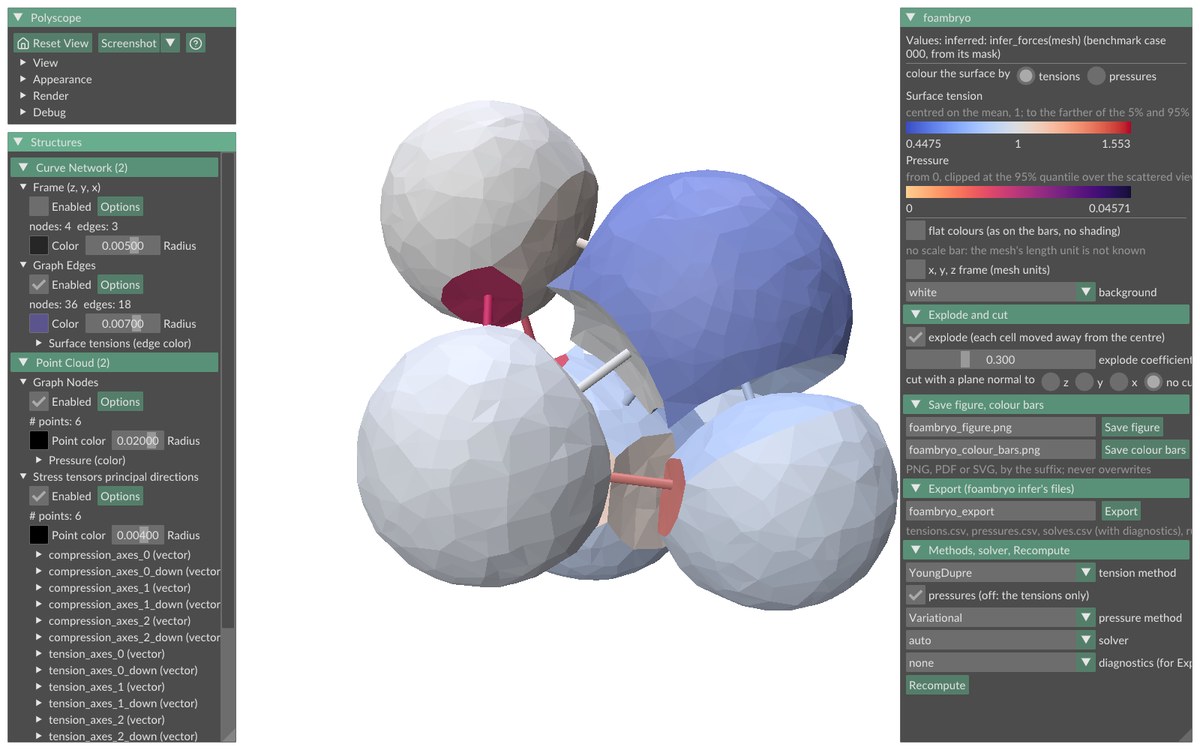
- Getting started: installation and three quick starts (Python, command line, napari).
- Methods note: what foambryo computes, and how to read its results.
- User guide: methods, cropped tissues, anisotropic voxels, large tissues, seed ensembles, viewers.
- Examples, one page each, every one runnable on generated data.
- The command line: every option, file, column, exit code and message.
- API reference, generated from the docstrings.
- Changelog and release notes.
If you use foambryo, please cite: Ichbiah S., Delbary F., McDougall A., Dumollard R., Turlier H. Embryo mechanics cartography: inference of 3D force atlases from fluorescence microscopy. Nature Methods 20(12), 1989–1999 (2023), doi:10.1038/s41592-023-02084-7.
foambryo is free software, under the GNU General Public License, version 3 or (at your option) any later version (GPL-3.0-or-later).